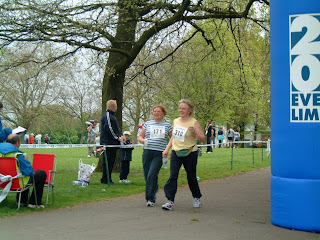
The Brockley Fun Run in words and pictures

Following Sunday's inaugural Brockley Fun Run, organiser Erin Essex said:

Congratulations and thank you to all those who participated in I Love Brockley Fun Run 2008 supported by The Brockley Cross Action Group (BXAG). Over 250 people raced up, down and around Hilly Fields on Sunday 27 April 2008. Over 100 local supporters come out to cheer the runners on.

They were running to help raise money for the Brockley Common, one of the BXAG’s main projects. The money raised will be used towardthe creation of the Common, a new open public space behind Brockley station ticket office. Please see the website http://www.brockley.com/bcag/ for more information as well as official race times.

The I Love Brockley Fun Run 2008 was a great way to encourage people to be fit, healthy and enjoy our wonderful green spaces in Brockley. There were two Sumo wrestlers, a devil, a North American native chief and a runner on stilts alongside families, prams, dogs and loads of local community runners. It was a truly amazing morning. It will definitely be anannual event!

The BXAG group has approx 30 “I Love Brockley” Badger t-shirts left from the limited edition 300 print. They are currently for sale for £10 at the Broca coffeeshop at 4 Coulgate Street, Brockley SE4 2RW. All the proceeds will go the BXAG.


Nu-Spice, Coulgate Street

BC review to follow. Please posts your comments and reviews here.

The Brockley Fun Run in Pictures

Thanks to Stuart for the pictures of the day.


Bringing the community together


Nothing says "fun run" like comedy glasses (the ones on the right)


Except possibly comedy sumos (and butterflies)

The tale of the tape

Thumbs-up from organiser Erin

The Big Match - Live!

The first time we clapped eyes on Ecosium it was a warm sunny afternoon, the windows were wide open on to the street. People sat drinking beer while wide-screen tellies played silently in the background.

Our immediate thought was that this would be the perfect place to watch World Cup and European Championship matches, in the summer. With England failing to qualify and Ecosium failing to create much of a "big match atmosphere", even on the best of days, we quietly abandoned those dreams.

This week's Champions League semi-finals (Manchester United v Barcelona, Chelsea v Liverpool) forces us to revisit the issue... where's the best place in Brockley to watch football?

The History of Brockley Cross

One of the things we underestimated when we started this blog was how great the appetite would be for local history - and how much knowledge would rest with our readers.

Following the recent article about the Knights Templar comes this article, contributed by Moira Tait, based on her own research. It tells the history of Brockley Cross in a time when locals may have suffered from Scrofula, but they were unafflicted by the double roundabout. It also explains why the tiny scrap of Common we have left is worth preserving.


The History of Brockley Cross by Moira Tait


If you read any local history about Brockley Cross, you’ll find no reference to it until the 19th century with the coming of the canal and the trains. While Brockley Green as a settlement (situated further south in the modern Brockley Rise area) does appear earlier, and the Manor of Brockley was in existence since the 12th century with the Premonstratensian Abbey founded near present St Peter’s church in c1187, the area of Brockley Cross is an unnamed meeting place of three roads. But if you look a little more closely at early maps, they suggest a more interesting history.

Most of the earliest maps of this area show three roads: The first road ran from the Cross area to Butt Lane (now Tanners Hill) and onto Deptford. (We know a settlement at Deptford was in existence in pre-Conquest times as it was called Mereton meaning ‘town in the marsh’.) The second road ran from Coulgate Street, along Brockley Road, onto Brockley Green near the site of the modern Brockley Jack pub. The third road ran from the Cross area south of Plow Garlick Hill (Telegraph Hill) onto Nonehead (Nunhead) and Goose Green. These are most likely Medieval routes because of the presence of the abbey near St Peter’s Church and Medieval settlements at Sydenham and Dulwich.

One of the earliest large-scale maps dates from 1741 and shows the junction of these three roads as a large diamond-shaped area. There are some buildings immediately to the east of this junction (on the site of Breakspears Road just north of the railway) which are named on later maps as Manor Farm. This farm supported the old manor house which may have been on the site of Breakspears Mews. Interestingly, the 1800 Milne map indicates field boundaries adjacent to Manor farm that show a reeve type pattern that probably goes back as far as the Neolithic period 5,000 years ago.


The junction at Brockley Cross has a number of features, namely a well and a few disparate buildings, typical of commons all over England and which were used to graze animals by anyone who lived locally to the common. The common was usually owned by the lord of the manor.

Brickworks on Plow Garlick Hill (Telegraph Hill) are first indicated on the Cole map of 1756 suggesting that the land had been sold and the new owners were no longer interested in farming. By 1775, the road to Nunhead and Goose Green appears to have truncated, only going as far as about Aspinall Road.

On the 1777 Andrews map, this road is extended north to New Cross Gate on present day line of Aspinall Road, crossing the railway to Waller Road.

By 1800 the road ceases to exist. Perhaps, the new owners of Plow Garlick Hill did not want anyone walking over their land or it may have had something to do with the military telegraph communication system established a few years earlier (hence the name Telegraph Hill). The common at Brockley Cross, however, appears not to have a name until 1800, when it is called Deptford Common. But Deptford Common used to be north of Hilly Fields. As this area was the first to be built upon, perhaps the name was re-allocated to the common at Brockley Cross.

Further changes in land ownership occurred in order to bring about the creation of the Croydon Canal and which destroyed the common in 1809. Its route followed Shardeloes Road, across the end of what is now Brockley Cross, along the western edge of Coulgate Street and then joined the line of what is now the railway. Even though it is hard to imagine a canal here, there are still traces to be seen. The retaining wall in the southern part of Shardeloes Road (site of the Brockley poem) reveals the cutting that gave a level section between two flights of locks of which were at least six locks between Brockley Cross and New Cross to be negotiated. A lock-keeper’s cottage named the Old Lock House was situated on the east side of the canal (Shardeloes Road) opposite Millmark Grove on the site of four modern garages. This cottage survived until the early 1940’s. The land on which it stood is a strange triangular shape and I believe is so because it was built on the common; its northern boundary is the edge of the common and the land adjacent was owned by someone else. The lock cottage land stretched into later Malpas Road and is marked by the four modern houses of 247-243A Malpas Road. When Malpas Road was built in the 1890’s a gap was left in the Victorian terrace for three houses - the builders were clearly expecting the cottage to disappear shortly! The later infill of the four houses rather than three explains the numbering of the fourth house as 243A.


The Canal was a financial failure and was closed in 1836 with the land sold to the new railway companies. It took three years for the London to Croydon Railway to open but there was no station at Brockley until forty years later in anticipation of the completion of the London, Chatham and Dover Railway route (to Victoria). This route opened its station Brockley Lane the following year (only to close during WWI as an economic measure). These two railways together with the canal finally obliterated all remaining evidence of the common. So the area of Brockley Cross, rather than being a simple junction of three roads, could have been a place where people grazed sheep, sold their goods at a marketplace and met for fairs. It may never have been deemed significant enough for mapmakers to name it, but in the lives of the people of Deptford, Brockley Green and Nunhead, the common at Brockley Cross was certainly known and used by them.


Thanks, of course, to Moira for her excellent work.

Tapastry Tapas Bar, Honor Oak Park

Our first visit to Tapastry last weekend was an enjoyable one, but the place seemed to suffer from a general lack of communication.

Just booking a table proved difficult enough, with us constantly reaching the answer machine. Eventually we received a message in return from Tapastry to confirm our booking, but it was left on our house phone, not the mobile number we’d supplied – useless, since we were out for the evening.

When we turned up, our name (or an interpretation of it) was scribbled in the book, but alas, no table. Not to worry, the manager was very welcoming, and we sat at the bar enjoying a lovely pint of Cruzcampo. We were offered a choice of tables, which were soon to become vacant, and informed the manager which one we’d like, but when it eventually became free, it was snapped up by a couple of passing buzzards, who swooped in before we could get off our bar stools. Rather than turfing them out of said hallowed table, we were then told that we should take a table in the corner or we ‘could be waiting for some time’.

For our food, we ordered a selection of hot and cold tapas, asking that the bread, olives, and manchego cheese be brought out first, before the warm dishes. As it all arrived together, five minutes later, we realised that this was not a place that plays by the rules, but one that just goes with the flow!

The food itself was excellent, and at a decent price. The atmosphere was also buzzing, and the music eclectic but cool (theme tune from Minder, anyone?). Tapastry is exactly the kind of place that Brockley Cross could do with, albeit slightly better organised. It is no doubt worth the walk to Honor Oak, and we’d love to know what you think. Perhaps try it on a weekday night.

Brockley in the media

The Guardian, April 25th

Brockley and New Cross each secured a mention in the Guardian's 'blog-by-blog guide to London', which sought out uncelebrated exotica in the capital. Obviously, anything in South East London, other than Greenwich, automatically qualifies as 'a secret'...

http://www.guardian.co.uk/travel/2008/apr/25/london.blogbyblogguide?page=2


The Sunday Telegraph, April 27th

Loft living in Honor Oak. Alright, not really Brockley, but it talks about the impact of the East London Line on the area...

http://www.telegraph.co.uk/property/main.jhtml?xml=/property/2008/04/27/plofts127.xml